
Search for the best places to stay in Bali and you will find long lists of hotels, yet a more useful first question is which part of the island suits the days you have in mind. For a first visit of about a week, two areas usually serve better than one, a few nights inland around Ubud, then the sea.
Our home is Jimbaran, where Balquisse Heritage Hotel stands among gardens a short walk from the bay, so we have a natural interest in where your journey ends. What follows walks through the areas a first visit usually touches, described by how a stay there feels from morning to evening, before coming home to our own corner of the island.
Before choosing a place, it helps to choose a shape. Under five nights, stay put. One well-chosen base will hold the whole trip. With a week to ten nights, two bases usually feel right, and only a longer journey really needs a third.
Order matters as much as number. Begin inland and finish by the sea, and the airport stays close at hand for the last night, which is a kindness before an early flight. Every move takes a good part of a day by the time you have packed, travelled and unpacked again, so a week spread across four or five places ends up mostly on the road. A single base often suits families with young children, too, and anyone who would rather not repack.
Distance asks for the same care. Bali has no railway. Every move between regions happens by road, and the roads take longer than a map suggests, so it is wiser to plan in hours than in kilometres and to resist crossing the island and back in a single day. Area names are generous, too. A hotel listed in Ubud may sit in a village well outside the town, and Uluwatu can mean much of the southern peninsula. Look at the exact pin before you book.
Ubud is where many first visits begin. The town sits inland, ringed by river valleys and terraced rice fields, and the island's arts feel close at hand here, from the royal palace in the middle of town to dance in the evenings, painters' galleries and craft studios, and a well-rooted community of yoga teachers and wellness retreats. Mornings suit a walk along the rice fields before the warmth of the day sets in.
Its centre is lively from morning until night and easy to explore on foot for short distances. Beyond it, the villages are greener and further apart, and reaching dinner or a gallery from them usually means a short drive. Many villas out there perch on the rim of a valley, with wide views and, often, a good number of steps between the road and the room. Ask about them if stairs are hard for anyone in your party.
Ubud has no beach, and that is the simplest answer to whether to choose Ubud or the sea. On a first visit you can have both, one after the other. Within a week, a few nights inland leave room to wander the town, follow a path between the terraces and catch a dance performance. Leave the coast for the second half.
The second half of a first visit is a choice between kinds of sea, and kinds of evening. Each coast has its own pace, and each answers a different idea of the days after Ubud. Here is how the main coastal choices feel.
On the west coast, the day ends facing the sunset. Seminyak gathers restaurants, boutiques and beach clubs within a fairly small area behind a broad beach, so parts of an evening can be spent on foot, and for many first-time visitors that ease is the draw. Canggu, further up the coast, took its shape from the surf. Its cafés, gyms and co-working spaces draw a younger, sociable crowd. They are spread across several neighbourhoods, among them Berawa, Batu Bolong and Pererenan.
Choosing between the two comes down to what you would like outside the door, whether dining and shopping within easy reach in Seminyak, or surf lessons and café mornings in Canggu. Canggu is lively, and its pace shifts from one neighbourhood to the next, so pick the part whose rhythm matches yours rather than the name alone. Along this coast, the beaches have dark volcanic sand and real waves. They are lovely for watching the evening sky and for learning to surf. For swimming, stay between the flags and take local advice on currents.
Sanur, on the east coast, is a sunrise town. Its beach sits behind an offshore reef, which keeps the sea softer than on the west coast, though the shallows come and go with the tide. A paved promenade follows the shore, and the cooler early hours are when people walk and cycle along it. Fast boats to Nusa Lembongan and Nusa Penida leave from Sanur, which makes it a practical place to sleep before a day on the islands.
Further south, Nusa Dua is a planned resort estate of landscaped grounds and reef-sheltered beaches, also facing east. Days there centre on the resorts and the shore, and dinner beyond the estate usually means a car. Families with young children often choose Sanur or Nusa Dua for the gentler water and level paths. If swimming is high on your list, these eastern shores are usually the easier choice, though it is still worth checking the tide each day and the steps at your own hotel.
Beyond Jimbaran, the south climbs onto the Bukit Peninsula, a limestone upland that ends in tall cliffs above the Indian Ocean. Around Uluwatu, many stays look straight out to sea from the clifftop, while the beaches lie below in small coves, reached by stairways that can run to many steps. Pura Luhur Uluwatu stands on the cliff edge at the south-western tip, and visitors gather there towards sunset. The reef breaks along this coast are known well beyond Bali and suit experienced surfers; if you are learning, the beaches of Canggu make a gentler classroom. Hotels on the peninsula sit far apart. Most days involve a car, even for dinner.
Further from the airport, the island opens into country that rewards time. Sidemen, in the east, is a valley of terraced fields watched over by Mount Agung, and Amed, on the eastern shore, is a run of fishing villages well known to divers and snorkellers. In the north, Munduk is highland country of lakes, waterfalls and forest. Lovina and Pemuteran lie along the northern coastline. People farm and fish in all of these places, and each deserves several nights of its own. In a first week they can feel like a long stretch. On a longer stay, or a return visit, they make a beautiful third chapter.
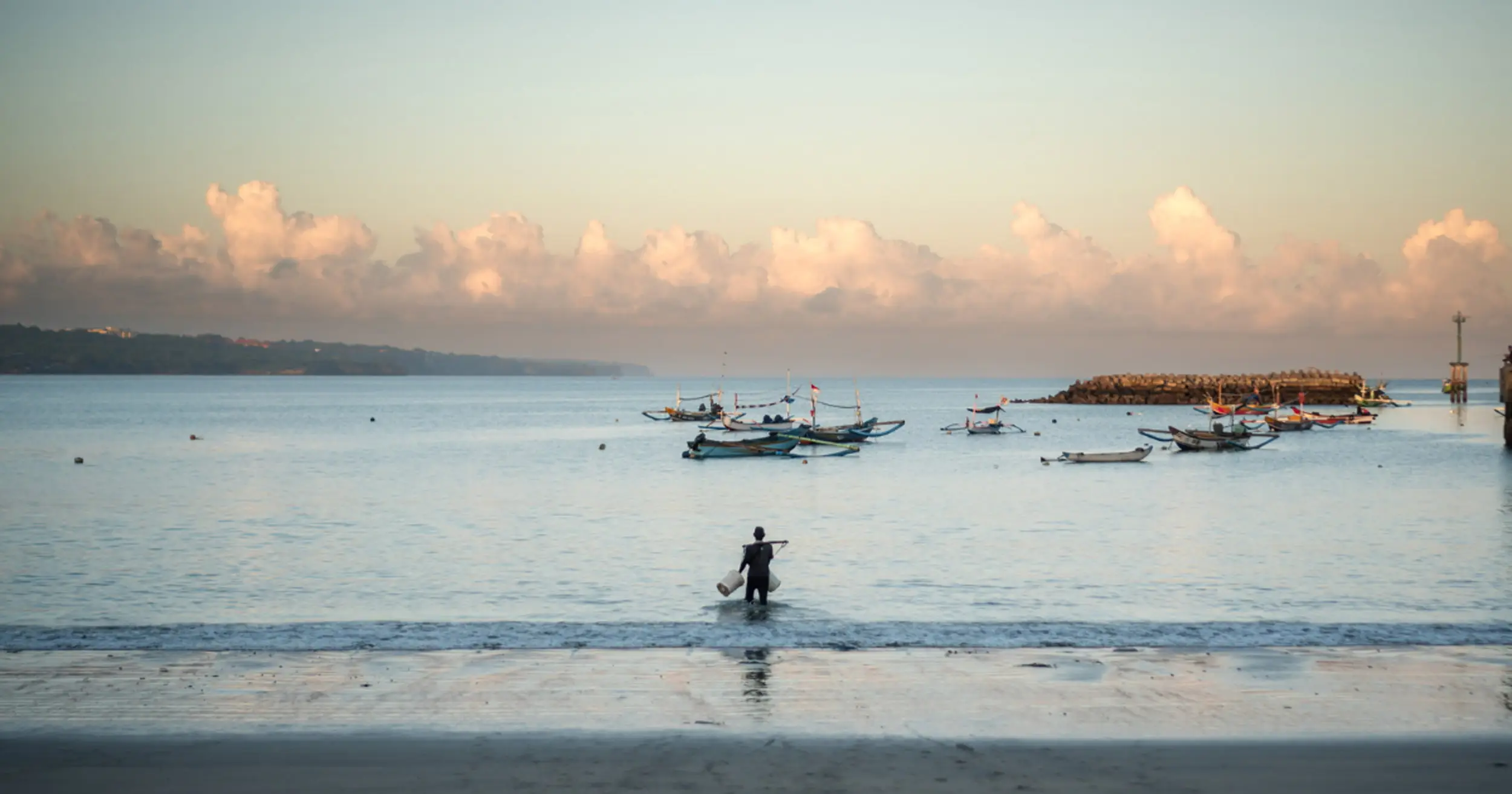
Is Jimbaran a good place to stay in Bali? For many first visits it is, especially as the coastal half of a split stay or the last stop before the flight home. Jimbaran lies on a sheltered, west-facing bay just south of the airport, where fishing boats rest on the sand by day and, at sunset, tables are set on the beach for grilled seafood. Nusa Dua and the cliffs of the Bukit are within easy reach. The honest conditions are simple. Evenings gather around dinner rather than late nights out, most outings beyond the bay and nearby streets need a car, and Ubud is too far for daily trips inland.
Jimbaran has more than one setting of its own, and our notes on reading the bay, the village streets and the hills look at choosing between them. If you are travelling as a couple, Jimbaran for couples looks at the bay from that point of view.
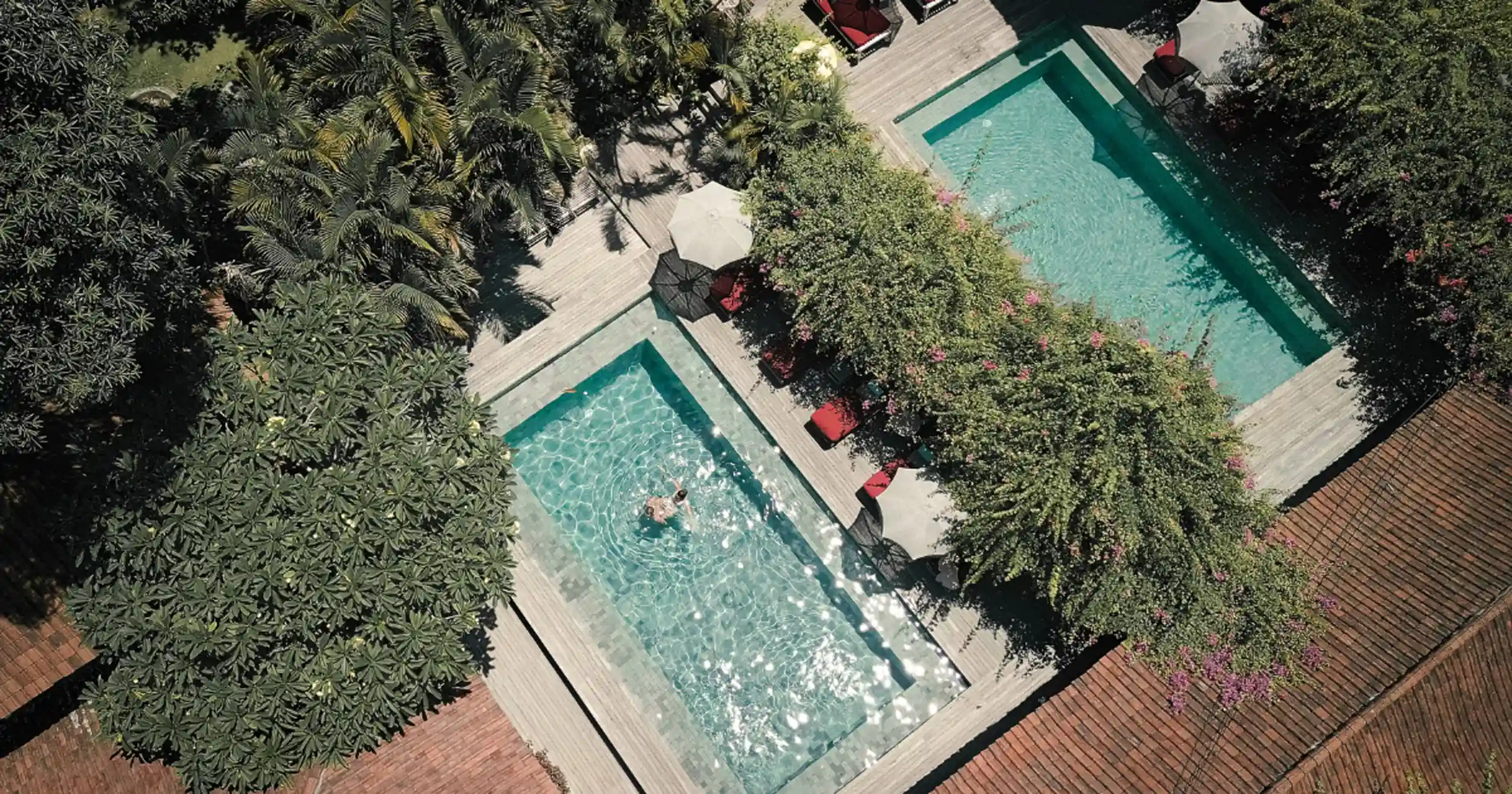
Balquisse Heritage Hotel stands on Jalan Uluwatu in Jimbaran, near the sand rather than on it, about 400 metres from Jimbaran Beach. Guests can ride down to the bay and back in a vintage Volkswagen or Jeep shuttle. The hotel's 21 individually designed rooms are set among gardens and four pools. Their interiors, collected over the years, draw on carved timber, antiques and handwoven textiles, so no two rooms are quite alike. Meals are served at Saybah Restaurant in the gardens. The Shaba Spa is open daily, with treatments booked at least a day ahead, and The Shaba Shala hosts yoga and meditation.
On a first visit, that makes it a natural second half after Ubud, or a gentle place for the final nights before the journey home. However you shape the days before it, our team would be delighted to help you make the most of your stay.