
A Balinese wedding, known in Balinese Hindu tradition as pawiwahan, is a religious rite of passage that joins two families as much as two people. It takes place before the divine, the ancestors and the community, and its shape changes from one village and one family to the next.
Here in Jimbaran, at Balquisse Heritage Hotel, we welcome couples who come to Bali to celebrate. That gives us an interest in the subject. So we keep to what Balinese scholarship and practice describe, and we say plainly where a visitor's blessing and a Balinese marriage part ways. What follows explains the ceremony as Balinese families keep it, and how visiting couples and guests can share in its spirit with care.
Pawiwahan comes from the Sanskrit wiwaha. In everyday Balinese, people simply speak of nganten, to marry. Within Balinese Hinduism, marriage belongs to manusa yadnya, the rites that mark a person's passage through life, and it opens grhastha, the householder stage, when a couple takes on a home, a family and duties to the wider community.
In Balinese custom, a marriage is valid when it has three witnesses, known together as Tri Upasaksi. Dewa saksi is the witness of the divine. Manusa saksi is the witness of family and community, marked by the presence of the customary village leaders. And bhuta saksi is the witness of the bhuta kala, given through the purification rite known as mabyakala.
Customary society in Bali is patrilineal. In the most common form, the bride leaves her parents' home and joins her husband's family, and with it the family shrine where his ancestors are honoured. Marriage may be arranged through a formal proposal, called memadik, or begin with an elopement, ngerorod, which custom also recognises.
Not every bride moves, however. In nyentana marriage, the husband joins his wife's family to continue her family line. In a newer form, pada gelahang, both spouses keep their standing in their own families. Bali's council of customary villages has allowed it, though opinion remains divided and it is not yet widely adopted.
It also helps to set aside comparisons that do not fit. Balinese Hinduism has a character of its own, distinct from Hindu practice in India and in Java. Balinese weddings have their own rites, their own terms and their own offerings, and they are better understood on those terms than as a version of a ceremony seen elsewhere.
No two ceremonies run quite alike. Balinese custom follows desa, kala, patra, the idea that place, time and circumstance shape how a rite is carried out, so the order, the names and the scale differ between villages and families. What follows is a typical sequence, not a fixed one.
It begins with the date. Families choose an auspicious day from the Balinese calendar, often after consulting a priest or an elder. Before the wedding the bride goes through ngekeb, a time of preparation and prayer in her family home.
On the day itself, the groom's family comes to fetch her. Mungkah lawang, the "opening of the door", is part of bringing her to the groom's home, and mesegeh agung follows as a welcome in which his family receives her.
Then comes mekala-kalaan, also called mabyakala. This is the purification at the heart of the day. Led by a priest according to local custom, it cleanses the couple in body and spirit, and it closes as the couple break a white thread tied between two branches of the dapdap tree, a sign that their youth is behind them and the householder stage has begun.
Mewidhi widana follows at the family shrine, where the couple pray and ask the ancestors to accept the union. Later, on a day both families agree, comes mejauman, a visit with offerings to the bride's family shrine, where she takes formal leave of her own family's ancestors. This leave-taking is known as mepamit, and some families hold it before the bride is escorted to her new home.
Put together, the rites can stretch across several days, from the bride's preparation to that return visit. Families may also hold a reception, or resepsi, where a wider circle of friends and neighbours comes to congratulate the couple.
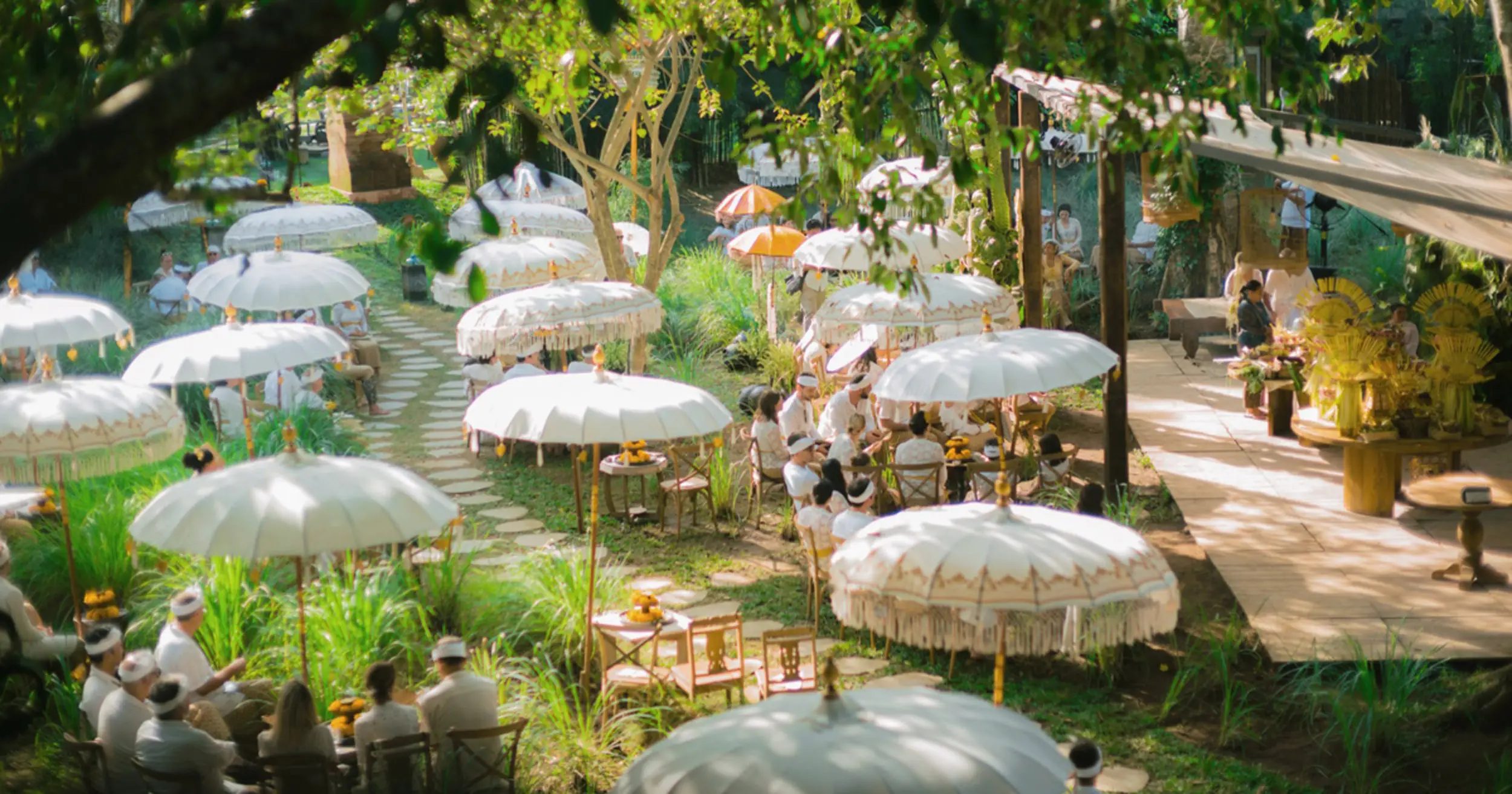
Offerings, called banten, carry religious meaning in every part of the ceremony. They are not decoration. Many are still made by women, with relatives and neighbours helping in a custom of unpaid mutual help known as nguopin, and offerings are also commonly bought ready-made at the market or from a tukang banten, an offering maker.
Two kinds of priest may take part. A pemangku is a lay priest who looks after a temple or a family shrine and leads many household and village rites. By contrast, a sulinggih is a consecrated high priest, known as a pedanda when he comes from a brahmana family. The roles are not interchangeable, and which priest leads which part of a wedding depends on the family, the village and the scale of the ceremony.
Bridal attire comes in three levels. Payas agung is the grandest, payas madya the middle form and payas nista the simplest. Payas agung was once reserved for royal families, and in it both bride and groom may wear a tall gilded crown. The bride wears prada and songket, cloth worked with gold, while the groom carries a keris, a ceremonial dagger.
Music has its place too. Gamelan often accompanies the ceremony and the gathering around it, though the ensemble depends on the family and the village, and no single repertoire belongs to every wedding.
How does a symbolic wedding differ from a legal one in Bali? A legal wedding is one that Indonesian law recognises. Under Law No. 1 of 1974 on Marriage, as amended, a marriage is valid when it is performed according to the religion and belief of each partner, and every marriage must also be registered. A symbolic wedding or blessing can be deeply meaningful, yet it creates no legal marriage, which is why some visiting couples choose to marry legally at home first. Couples who marry legally in Indonesia register the marriage with the civil registry, or with the Office of Religious Affairs (KUA) for Muslim couples. The authorities and your embassy can confirm the current requirements.
Blessings for visiting couples are offered by many wedding planners in Bali. A Balinese priest leads prayers, with offerings and holy water, and some couples wear Balinese ceremonial dress for the occasion. Such a blessing is sincere, and it deserves the same respect as any rite. It is still not a pawiwahan. The heart of a Balinese marriage lies in a family and its shrine, in ancestors asked to accept a new member, and that belongs to Balinese Hindu families themselves.
If you are offered ceremonial dress for a blessing, wear it as a mark of respect for the occasion rather than as dressing up. Ask the officiant what is appropriate.
For the practical side of marrying here, from legal steps to choosing a season, our guide to planning a wedding in Bali goes into more detail. Couples drawn to something more intimate may also enjoy our notes on a smaller ceremony with only a few witnesses.
An invitation to a Balinese wedding is a generous thing, and non-Hindu guests are welcome when they have been invited. Follow the lead of your hosts and the priest. Some parts, especially the prayers at the family shrine, may be meant for family alone, and anyone who has not been invited should not enter a family compound to watch.
Dress modestly. Balinese ceremonial dress pairs a kamen, a wrapped cloth, with a sash, and women wear a kebaya, so ask your hosts what they would like guests to wear. Never step over or tread on an offering, and never block offerings, shrines or a procession. Follow the guidance of the priest or your hosts, and ask before taking photographs up close.
Bali's provincial government sets out similar expectations for foreign tourists. Governor's Circular No. 7 of 2025 asks them to honour temples and sacred symbols, to respect ceremonies and to dress modestly, and it bars them from a temple's inner and middle courtyards except to pray, wearing Balinese dress and not while menstruating. Weddings usually take place at a family home rather than a temple. Still, the same respect applies, and a host family can tell you about any customs of its own.
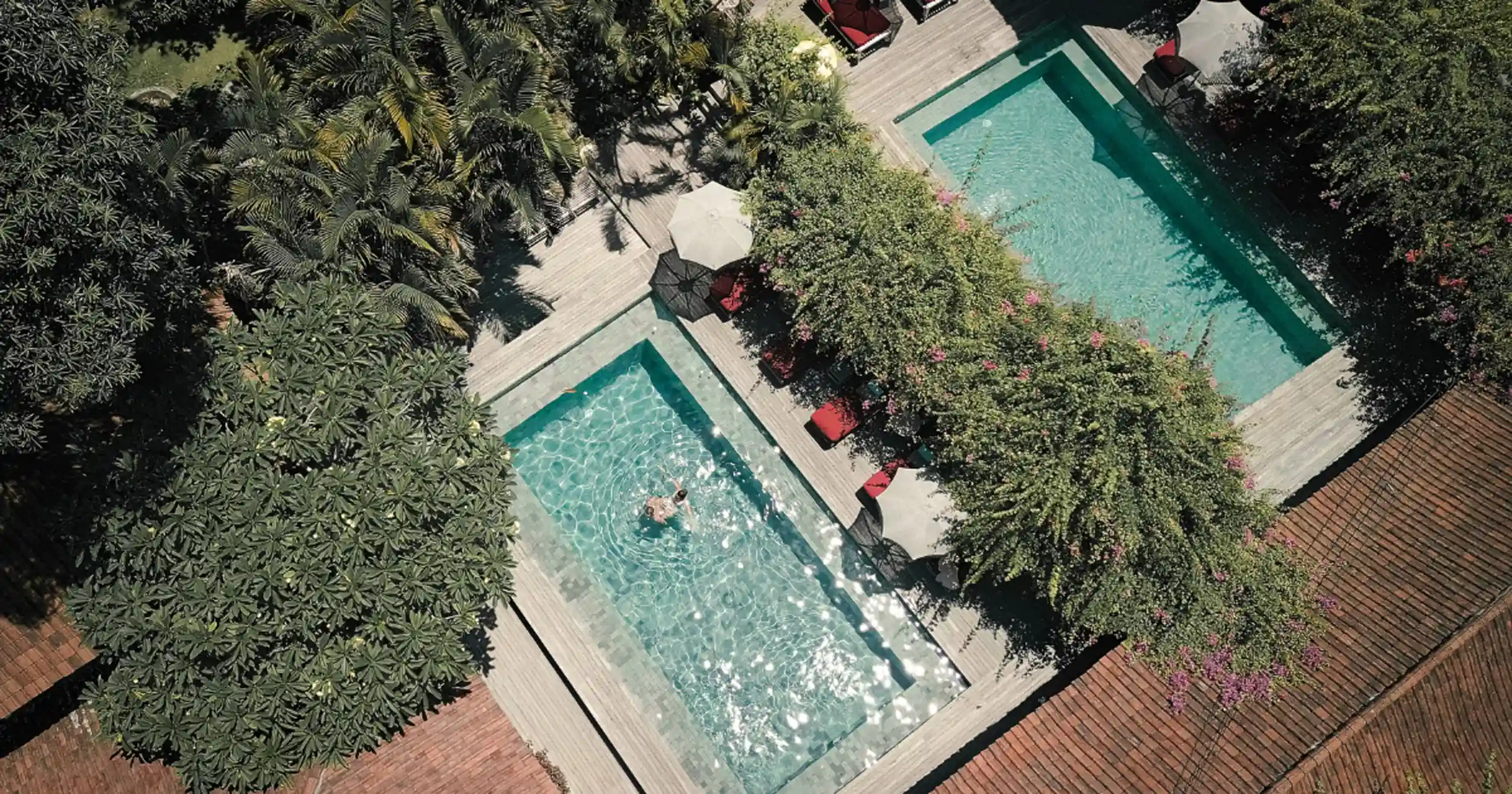
Jimbaran has a rhythm of its own, with fishing boats drawn up on the bay, the market at Kedonganan and the island's ceremonies part of daily life. At Balquisse Heritage Hotel, weddings and celebrations in the gardens may be arranged, as well as at The Shaba Function House.
Indonesian craft shapes the setting, with carved timber, collected antiques and two traditional Javanese gladak teak houses, Sangon and Sangitani, set among frangipani and garden paths. Guest numbers, arrangements and dates are worth discussing with our events team, who can tell you what is possible for the day you have in mind.
Separately from any wedding plans, The Shaba Spa menu lists a Melukat Ceremony at The Shaba Shala, a purification guided by a pemangku. It is not a wedding and does not take the place of one. The spa asks for bookings at least 24 hours in advance.
However you choose to marry, Bali's own traditions are worth understanding before the day. They are older than any celebration we host, and they belong first to the families who keep them.