
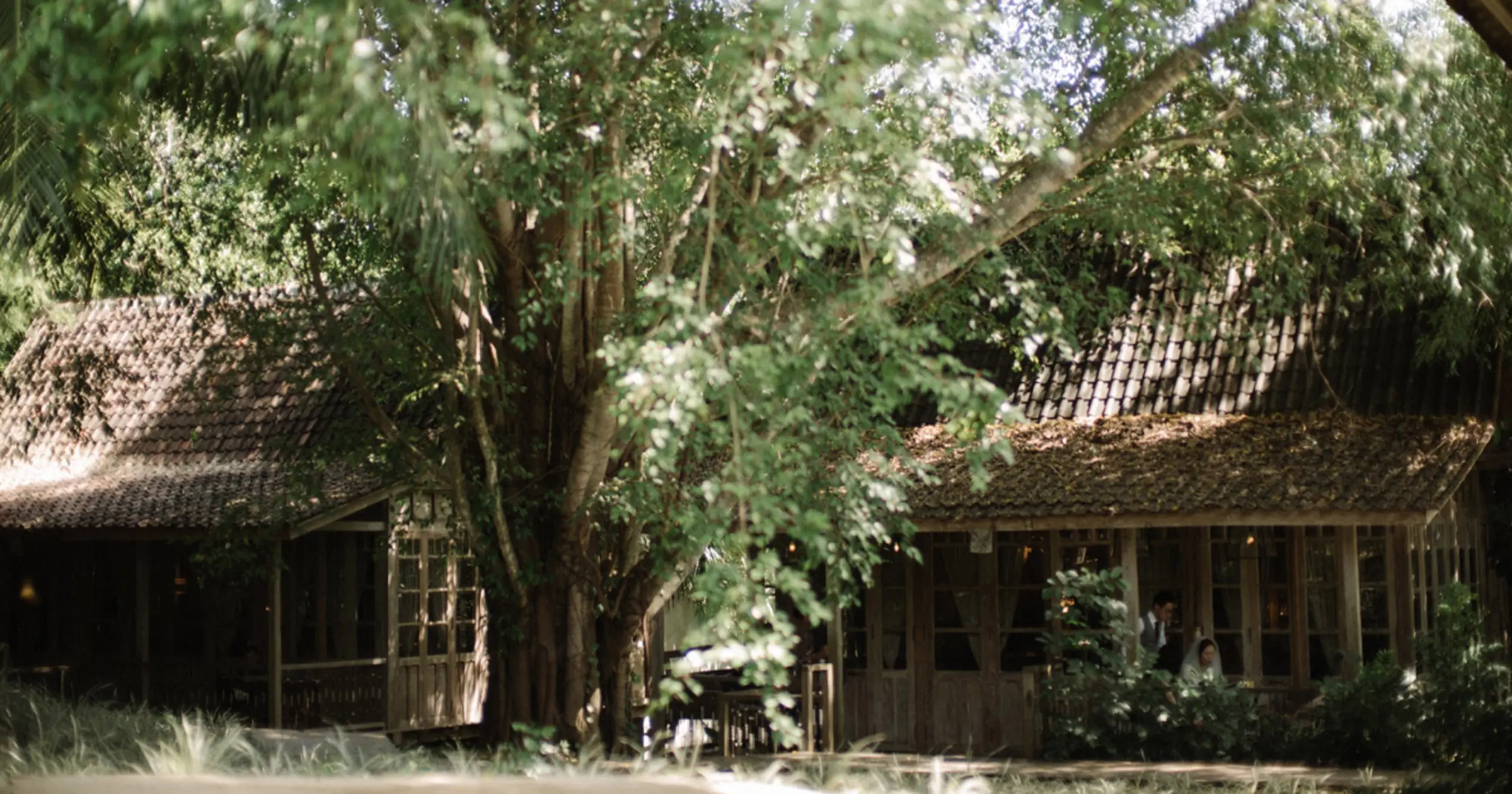
A unique place to stay in Bali is a traditional Javanese teak house, a timber home first raised in Java, then carried to the island and given a second life as somewhere to sleep. Its frame rests on posts and fitted timber joints, its walls are worked in dense, golden wood, and its carpentry still shows the hands that shaped it.
At Balquisse Heritage Hotel in Jimbaran, two of the 21 rooms are teak houses the hotel calls gladak, and what follows is a closer look at the craft behind them. Used loosely, the phrase "teak house" travels widely, and elsewhere it may lead to a restaurant, a furniture maker or a modern house that borrowed the name. In Java it means something older and more particular, a way of building in timber that produced the joglo, the limasan and other, less documented forms.
Teak names the material. The roof names the house. Javanese builders classed their homes by roof form, rising from the plain kampung through the limasan to the joglo, and for generations that order mirrored a household's standing. With its tall central roof, the joglo belonged to palaces, official residences and the aristocracy, although architects who restore these houses point out that colonial-era trade later put it within reach of wealthy commoners.
Not every teak house is entirely teak, either. Jackfruit wood was also used, and researchers who study reconstruction count it among several woods that can stand in for teak in repairs. Most Javanese houses sit on stone bases rather than piles, which sets them apart from the raised teak houses of Thailand, although raised forms are recorded in Java as well. Even a single type varies. A study of ten rural areas in Central Java found joglo and limasan houses shaped differently in each area, in tune with local nature and social life.
Laid out in full, a household unfolded as a sequence of spaces, beginning with the pendopo at the front, an open pavilion of many posts for receiving guests, then the pringgitan, and finally the dalem, the enclosed heart of the home. Not every house had all three.
Teak, Tectona grandis, rewards patience. Its heartwood is rated very durable, resists termites well and is valued for keeping its shape. Wood scientists credit much of that durability to natural compounds such as tectoquinone. Silica in the wood is enough to blunt a carver's tools, so fine work in teak has always asked for skill as well as time.
Not all of the tree is equal. In one study of plantation teak, the outer heartwood proved very durable and the paler sapwood only moderately so, a reminder that heartwood is the part that lasts.
Java's teak forests have a long and complicated history. From 1808, under Governor-General Daendels, the colonial state took control of the island's teak, the labour that felled it and the shipbuilding it supplied. Much of Java's state forest is still managed as teak plantation today by the state forestry company, Perhutani, and many of those plantations were first laid out in the colonial period.
At the centre of a joglo stand four principal posts, the saka guru. They carry the tumpang sari, a stepped crown of beams that rises in tiers beneath the highest part of the roof. Plainer in structure, a limasan has a hipped roof that runs along a ridge and no tumpang sari. In both, the posts usually rest on umpak, stone bases that keep the timber clear of damp ground.
The frame itself is a matter of joinery. Beams meet posts in mortise-and-tenon joints, and practitioners who restore these houses say every member, and every kind of cut, has its own name. Architects who restored a joglo from Gunungkidul, in the Yogyakarta region, describe the type as joined with wood alone, without glue or metal. That is a practitioners' account rather than a rule tested on every house, yet it shows how far the method could be taken.
The knowledge was written down as well as handed on. One carpentry text, the Kawruh Kalang, was compiled at the Surakarta Kepatihan in 1882 for an international colonial exhibition in Amsterdam, and model houses were sent alongside it.
Where a Javanese house needed a wall with presence, it often used a gebyok, a partition of wooden panels, often carved, sometimes a facade, sometimes an inner screen set with doors. In the houses of the nobility, a gebyok could mark the threshold between the public pendopo and the private inner house. Around Surakarta, a study of village houses found that the panels of the front gebyok always come in odd numbers, three, five or seven.
Regional styles differ. On the north coast, houses in Kudus are known for intricate carving, pierced in places in a style called krawangan, and the traditional Kudus house has no pendopo, receiving guests behind a carved wall with three doors. Motifs are mostly flowers and trailing plants, sometimes with birds or other animals, and their meanings vary by region and maker, so any single reading deserves care.
Across Bali, carved Javanese gebyok doors now appear in contemporary interiors, often as decorative pieces rather than working walls. Recent interior design research describes the shift, in which the gebyok is valued less as a sacred dividing element and more for its decorative beauty, its visual identity and the prestige it lends a room.
Teak changes as it ages, though not always in the same direction. Indoors it tends to deepen in colour. Left untreated in the open, its surface is widely described as turning a silvery grey.
Telling old timber from new is harder than it sounds. Density, the share of heartwood, tool marks, wear around the joints and the patina of long handling all help, but no single test settles it. A record of where a house came from tells more than any one clue.
Nor is any house type earthquake-proof. Posts set on stone bases can slip in a strong quake, and the 2006 Yogyakarta earthquake severely damaged joglo buildings and destroyed some of them, so any claim about resilience deserves caution.
Because a jointed timber frame can be taken apart, a teak house can travel. That same Gunungkidul joglo shows how carefully this can be done. It was assessed with local carpenters, analysed, dismantled and catalogued piece by piece, then stored before being rebuilt for a new purpose, its roof becoming part of a performance space with steel added where needed. A house can be conserved and changed at once.
There is a harder side to the story. A peer-reviewed anthropological study of the joglo traces how many of these houses, despite their standing as local heritage, have been sold and moved away from their home regions, some finding new lives in Bali's tourism, arts and craft industries. Others in Java are simply demolished, and changes such as replacing the saka guru with a steel frame to open up the floor remain contested among heritage specialists.
For anyone staying in a relocated house, it helps to think of a spectrum. At one end stands an intact antique house, then an antique house restored with some members replaced, then a new frame made from salvaged teak, and at the far end a new building in the traditional form. Each has its own value, and each is worth naming honestly.
Balquisse Heritage Hotel gives the name gladak to its pair of traditional Javanese teak houses, Sangon and Sangitani, and lists them together as its Vintage Teak Houses. Both houses came from Java and were given a second life in Jimbaran.
Sangitani is raised on stilts above the mangrove. Inside, the teak is aged throughout, furnished with a canopy daybed, antique pieces and chandeliers, and its name draws on "sangit", a root word tied to melody. Sangon, the second and more secluded of the pair, sits deep in greenery, its aged structure and handcrafted joinery left in view. Each house measures 90 square metres and suits two guests, with a super king bed, a bathtub and shower, and private space outdoors.
Through the interiors runs the collector's eye of Zohra Boukhari, founder and interior designer of the hotel, who has brought together carved panels, antique furniture, ceramics and textiles across many years. For a guest, much of the pleasure lies in reading the frame, in where a beam meets a post, how a joint is fitted and how the grain runs along a hand-worked surface. Carpenters in Java named, recorded and carried these details from one place to another for generations.
The rooms also have stories of their own, and how the hotel's rooms came to be is told in full elsewhere in the journal.